
Mastery Learning: Why Bloom's Idea Only Works Now
Anyone can build a chatbot that answers questions. The real innovation at TreadEd is a didactic idea that's almost 60 years old – and why AI finally makes it affordable for everyone.
Anyone Can Build a Chatbot That Answers Questions
TreadEd recently got an AI companion. Of course you can ask it questions, just like the countless ChatGPT variants currently being built into every learning system. We have that, it's checked off. And honestly, it's not the interesting part.
What else is new, from diagnostic steps to voice mode, is described by Christoph in From Training to the Real Thing. This article is about the didactics behind it. And that's almost 60 years old. It's called mastery learning, and it comes from Benjamin Bloom.
Bloom's Idea: Learning to Mastery
In 1968, education researcher Benjamin Bloom published a short essay titled "Learning for Mastery" (Bloom, 1968). He later shortened the name to "Mastery Learning" (Guskey, 2007).
Bloom's starting point was a simple observation. If everyone gets the same instruction in the same amount of time, results spread out like a bell curve. A few do very well, most are average, a few fail. Bloom didn't see this as a law of nature, but as a consequence of instruction. Given the time and support each person needs, the large majority can genuinely reach a goal (Bloom, 1968).
His method is simple. Material is broken into units with clear learning goals. After each unit comes a short test that isn't graded, but informs. Bloom called it formative. Anyone who hasn't yet reached the goal gets targeted corrective instruction, explaining the material differently than the first time instead of simply repeating it. Then a second, equivalent test follows. Anyone who has already reached the goal moves on to enrichment (Guskey, 2007).
Assessment was only ever "mastery" or "not mastery", and the latter always counted as provisional (Bloom, 1968). There was no failing. Only not yet.
One-on-One Tutoring Works, But It's Not Affordable
In 1984, Bloom compared three approaches: conventional instruction, group-based mastery learning, and one-on-one tutoring. Group-based mastery learning raised performance significantly. But with one-on-one tutoring, the average learner outperformed 98 percent of the comparison class (Bloom, 1984). Later studies found smaller but clearly positive effects (Kulik et al., 1990).
Group-based mastery learning was therefore a compromise. A single teacher can't accompany every person individually. So material gets broken into small units, tested after each one, and reworked where needed. A good tutor, by contrast, notices in conversation exactly where something isn't clicking and reacts to it. One-on-one tutoring for everyone was just never affordable.
Why We Still Learn in Courses
If mastery learning works this well, why does almost everyone still learn in courses that run the same for everyone? Because Bloom's method is labor-intensive. Every unit needs a test, every typical mistake needs a matching correction, and someone has to evaluate and assign it (Guskey, 2007).
A course, on the other hand, is produced once and distributed to everyone, in the same order, with the same final exam. What someone can't do often only surfaces at the very end. The gap is identified, but not closed.
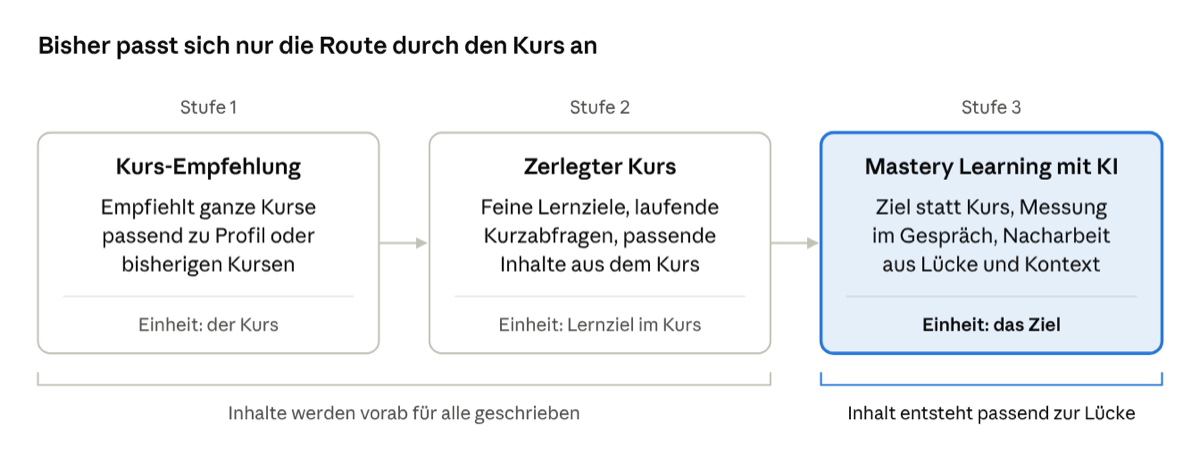
Digital learning systems have since automated Bloom's compromise. They break courses into small learning goals, check them with short quizzes, and serve up matching content.
But even here, the frame stays a pre-written course. Content has to exist in advance for every possible gap. And what gets measured is mostly whatever can be evaluated automatically – multiple choice rather than explanation.
What AI Changes
Two bottlenecks have held mastery learning back so far. Both are disappearing right now.
Assessment can happen in conversation. Until now, only what could be marked right or wrong could be evaluated automatically. Whether someone could explain, justify, or apply something had to be judged by a human. Today, diagnostics can run like an oral exam, as often as needed. Instead of once at the end of a unit, measurement can happen almost continuously.
Corrective instruction no longer has to be pre-produced. Bloom required that corrections approach the material differently than the first pass. AI can do exactly that for every single person, with a new explanation, an exercise, or a role-play, and with examples from their own everyday life. People still plan how learning happens. AI adapts it to each person.
Early controlled studies support this. A didactically designed AI tutor gave students more than twice the learning gains of active in-person instruction, in less time (Kestin et al., 2025). A chatbot without didactic guardrails, on the other hand, can harm learning (Bastani et al., 2025). What matters is the didactics, not the language model.
How We Built It
At TreadEd, people learn in conversation, and that already delivers a lot of diagnostic signal. Anyone asked to explain something reveals, along the way, what they've got and what they don't. The AI asks follow-up questions, spots misunderstandings, and works through them directly with the person. Targeted, personal follow-up work is already built into every learning step.
Diagnostic steps make this even more precise. They don't teach, they check, in writing or by voice, against clear criteria for what has to be solid. A good impression becomes a precise finding. That creates a loop. It starts with a goal. Diagnostics show where someone stands. Only what shows up as a gap gets reworked, then it's measured again. Once the gap is closed, the next sub-goal follows. The AI companion holds this loop together.
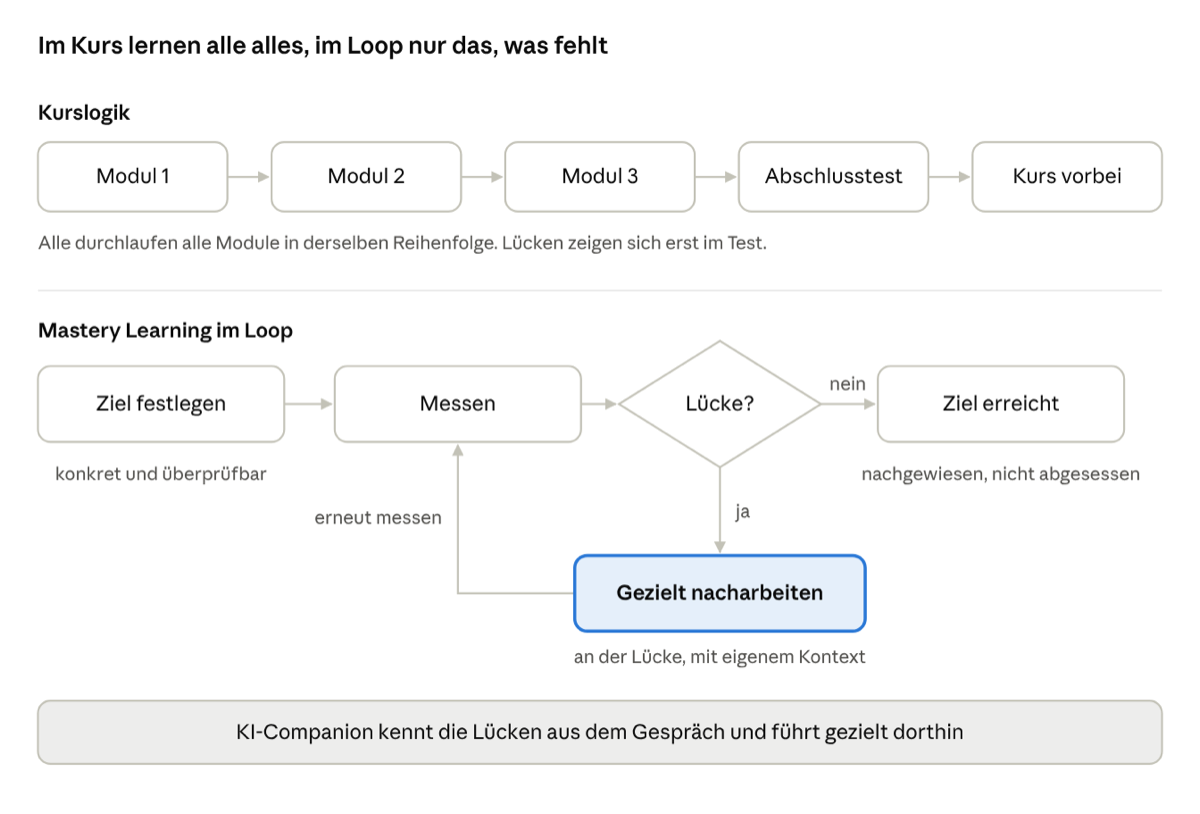
A course runs the same way for everyone. The loop only takes an extra round where measurement shows a gap.
What Follow-Up Work Actually Means
Following up doesn't mean rereading a chapter. It means starting exactly where something isn't clicking. That requires knowing where that is. That's exactly what the AI companion can do.
It knows the gaps. The companion knows from conversations what someone can already explain confidently and where it's shaky. Not as a score, but concretely – say, that someone mixes up two terms or is always unsure about a particular question.
It addresses them specifically. Instead of repeating the whole topic, it zeroes in on exactly that spot, with a different explanation than the first time, the way Bloom required for corrective instruction, and with examples from the person's own everyday life.
It proactively leads there. Learners don't have to know themselves what they're missing, or ask the right question. The companion suggests on its own where to go next, and then checks whether it has landed.
Here's what that can look like. Lea works in procurement. Her company is rolling out AI assistants, and Lea is supposed to be able to use them confidently day to day. In conversation, she explains well how to give an assistant clear instructions. Then she mentions, in passing, that the assistant surely knows the current supplier prices. That's the gap. A language model doesn't know anything about that at first. It only reaches a pricing database or ERP system through tools someone has connected, so-called tool calls. The companion picks up on this on its own: "Earlier it sounded like you thought the assistant just knows your prices. Want to take a quick look at how it actually gets that data?" Lea then sketches out, for her own supplier comparison, which tools the assistant would need and where she wants to grant access herself. A check-in question follows. If the answer holds up, they move on.
Starting From the Goal
For Bloom, what counts as mastered is fixed before learning starts. That goal is allowed to be big. The loop breaks it into sub-goals and works through them one by one. Two examples show how different such goals can look.
Passing an exam. Whether it's a final exam in vocational training or a certification, the goal is clearly defined. The exam regulations set out what has to be mastered, and often how it's tested. So assessment happens in the exam format itself, for example as a simulated oral exam. The loop ends once the simulation holds up.
A competency for a business goal. Many learning goals don't need an exam. They follow from what a company wants to achieve. If a company rolls out AI assistants in procurement, as with Lea, teams need to be able to use them safely. That means it has to be clear what they should be able to do afterward – for example, judge where an assistant needs access or approvals, and check its results. And what's out of scope, like programming.
This clarity isn't a minor detail. Only someone who knows where the goal is can measure how far someone still is from it. For L&D, that means competency is no longer counted in hours completed, but in demonstrated ability.
What This Delivers
Less time. Say someone already has two-thirds of a topic down. In a course, they sit through all of it anyway. In the loop, they only work through the last third.
Lower cost. Learning time is work time. Every hour that doesn't go into something already known stays on the job. And training no longer has to be bought as a package – it targets exactly where something is actually missing.
Gaps closed with precision. Measurement doesn't just show that something is missing, but what. Follow-up work happens exactly there, and the next measurement shows whether it was enough. That's the difference between "completed the course" and "can do it now".
Personal context. In a course, everyone gets the same examples. In the loop, each person brings their own context – their everyday work, their cases, their questions. Explanation and practice happen on what's actually occupying them. That makes what's learned easier to transfer.
What This Means for Courses
Bloom described almost 60 years ago how learning should work. What was missing was a way to make it affordable for everyone. That way exists now.
Courses won't disappear overnight. But they're losing their role as the unit around which learning is organized. The goal is the unit. Content, exercises, and exams become building blocks that get used exactly when they're needed.
For education providers, that means their value lies less in the finished course than in clearly defined goals and good measurement. For L&D, it means training can finally be measured by whether people can do something, not by whether they showed up.
Sources
Further studies and background for this article:

About the author
Daniel Kaulbach is Co-Founder of TreadEd.
TreadEd is a creator tool that makes it possible to design dialogue-based learning paths in which learners are always optimally supported through one-on-one guidance by an AI tutor. Experienced employees fully shape the tutor didactically, passing on their knowledge and experience at scale.
Related posts
From Training to the Real Thing: What's New at TreadEd
With our new release, learners can show what they know and speak freely instead of typing. Creators get an agent that keeps the whole learning path in view. Christoph explains why these belong together.
October 14, 2026
“A Protected Space to Practice”: Why LeWe GmbH Works With TreadEd
Alex and Martin from LeWe GmbH share why they've built TreadEd into their trainings and workshops – and how a protected space to practice elevates their work as trainers and consultants.
July 30, 2026
Understanding Is More Efficient Because It's More Robust – and More Robust Because It's More Efficient
Christoph explains why understanding concepts is both economically and cognitively more efficient than memorizing facts – and why that matters more than ever in the age of AI.
July 14, 2026