
From Training to the Real Thing: What's New at TreadEd
With our new release, learners can show what they know and speak freely instead of typing. Creators get an agent that keeps the whole learning path in view.
A few months ago, I described TreadEd here as an “ergometer for the mind”. An AI assistant takes resistance away from us; a good tutor gives it to us, exactly as much as we need in order to learn.
But resistance alone doesn't motivate anyone. Nobody gets on an ergometer because they enjoy sweating. We train toward something, and we want the effort to land where it makes a difference.
That's what our new release is about. Two new features make learning more motivating: diagnostics give learning a goal, and voice mode puts the effort into thinking instead of typing. The third is for the people who build learning paths: the workspace agent.
For learners: motivating people to think
A goal worth working toward
My clearest memory of preparing for my final school exams is the booklets with past years' papers. Working through them wasn't about knowing everything right away; it was more of a reality check. Am I prepared well enough? Where am I solid? Where not yet?
An exam situation causes stress when target > actual, or when it's unclear how target and actual relate to each other (target ? actual).
Practice exams can give learners a clear sense of whether actual = target. And if not, they can turn an actual < target into an actual → target.
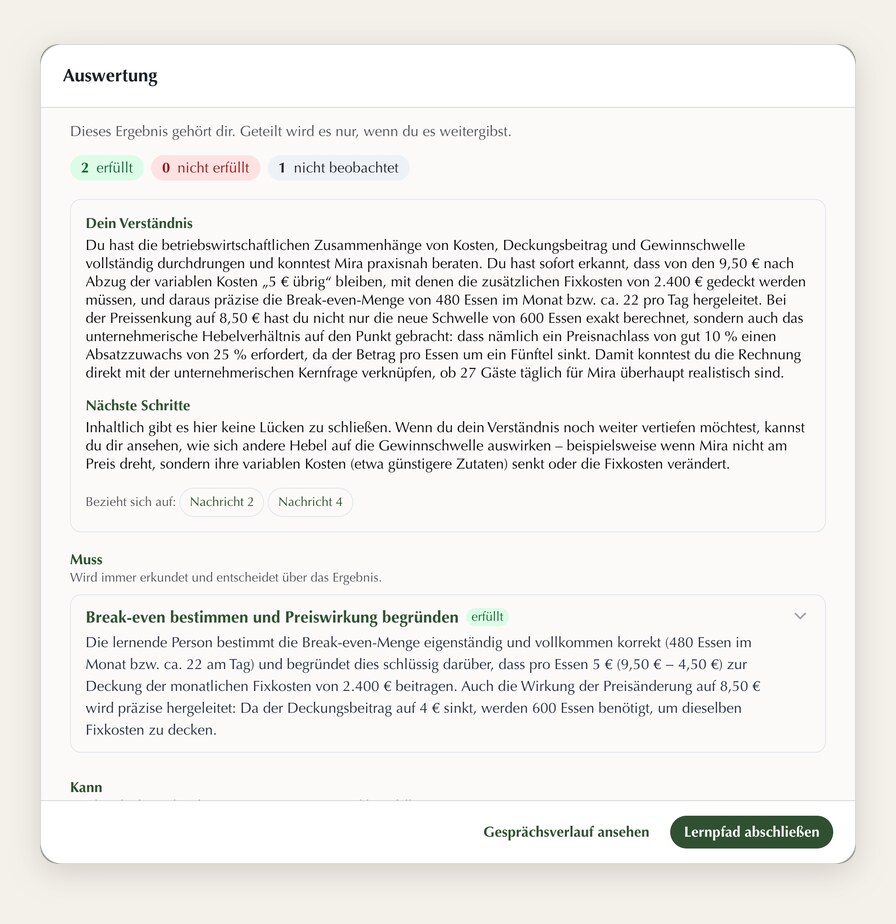
That's exactly what diagnostic steps are for. With them, learners get a target to work toward, and the learning steps get the valuable actual they need to close gaps in a targeted way.
It's as if your teacher graded those practice exams so you could then work on exactly the gaps that remain.
Speaking instead of typing
Sometimes the resistance in learning sits in the wrong place. Not everyone types fast, and in many situations where we could be learning, our hands are busy with something else.
The new voice mode lets learners have a spoken conversation with the tutor. Switching back to the familiar writing mode is always possible.
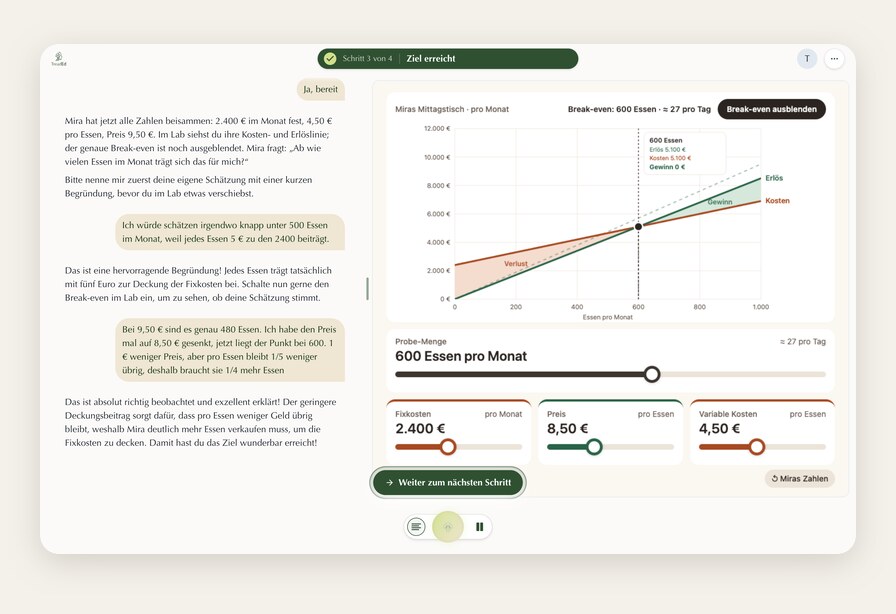
On small screens in particular, this frees up the view and, among other things, makes labs usable on mobile devices.
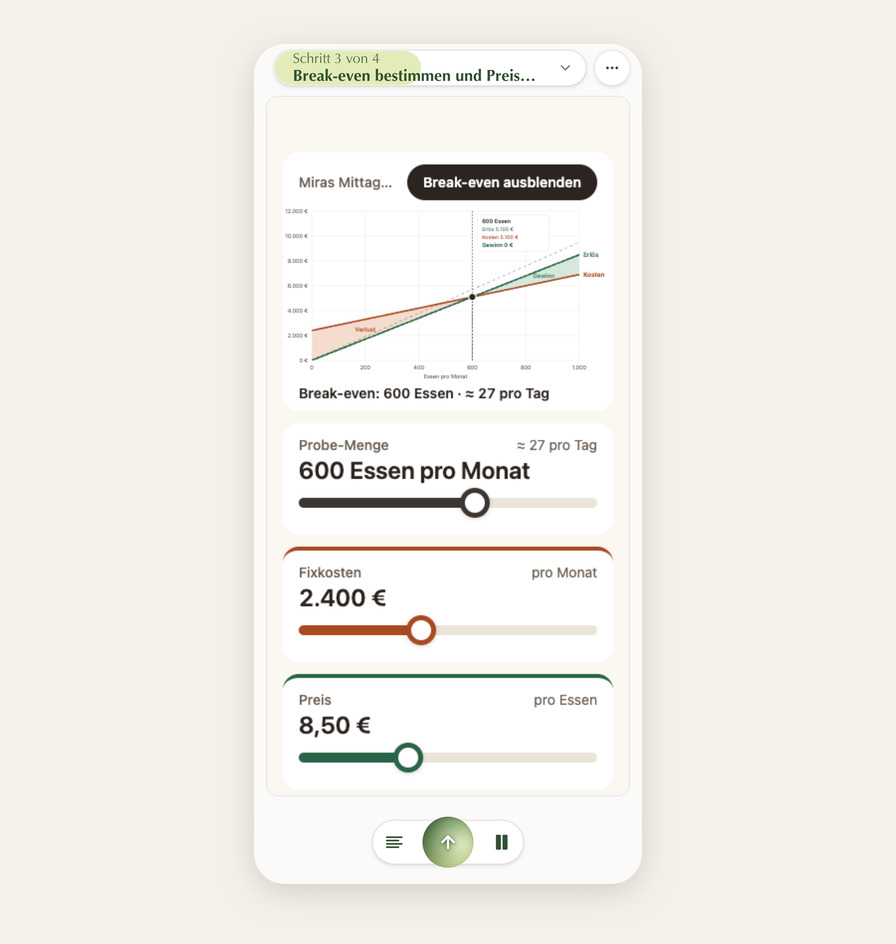
And even without a lab, voice mode can work like an interactive podcast: a conversation with an expert in which learners have to think along actively.
Both together: the oral exam
Voice mode and diagnostics also work together, in an oral exam, with or without a lab. Learners explain, justify and respond to follow-up questions in real time.
Every answer is information about the actual, and with narrowing and optional criteria, intelligent adaptive follow-up questions can map a whole cluster of relevant criteria precisely and enrich the learning process that follows.
For creators: seeing what works, and designing more freely
Feedback that belongs to learners
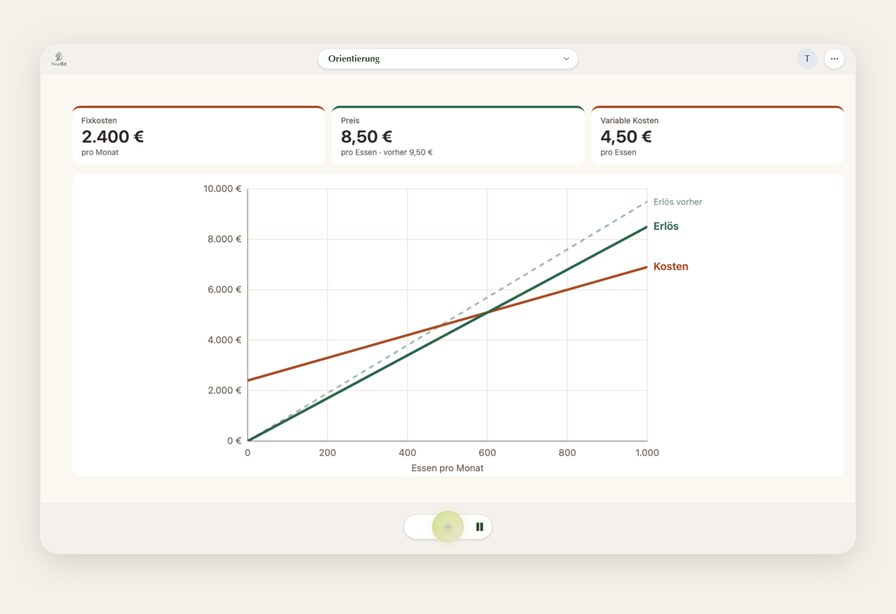
Diagnostics have a second side. For creators, they answer a question they ask themselves all the time: Does my learning offering actually work?
One principle matters to us here: Results belong to the learners. They stay in the learner's profile and are shared only if learners actively choose to: with the provider of the content, either the result alone or together with the conversation, and revocable at any time. If someone disagrees with an assessment, they can file an objection, and the host takes a look.
An agent that keeps the whole in view
The third new feature is about creation itself. With the workspace agent, learning paths now take shape in a conversation with an agent that keeps the entire path in view: the learning steps, the labs, the role-plays and the diagnostics at the end.
Creating should feel free, and still everyone should get the orientation they need. The workspace agent turns the potential of AI into an intelligent companion that supports you freely as you create: with an eye on the whole, and with the tools and the freedom to turn exactly the dials you're working on right now.
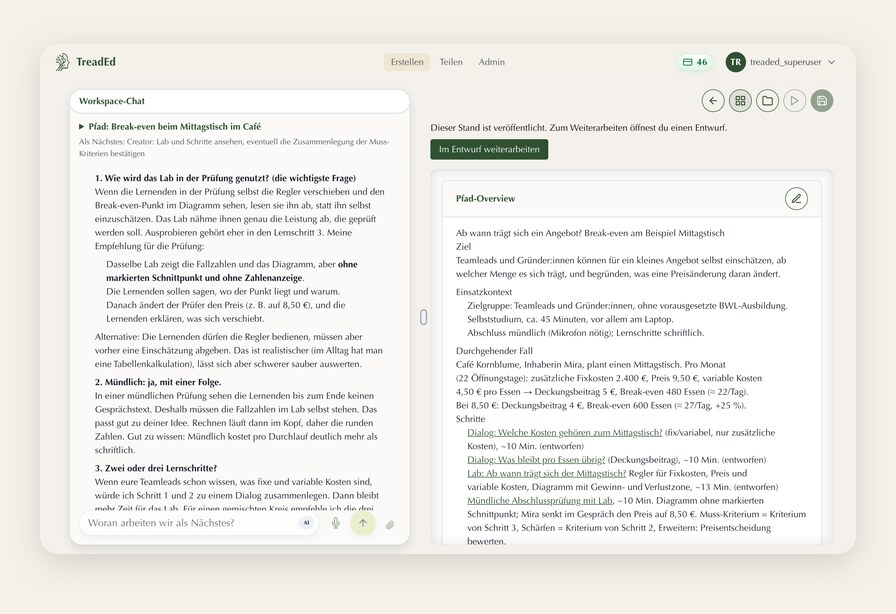
Just as voice mode gives learners more freedom to think, the workspace agent gives you, our creators, more freedom to design.
Existing formats remain compatible, of course, but diagnostic steps can only be built with the workspace agent.
In short …
… learning with TreadEd becomes more goal-directed and more free:
- For learners, diagnostics give learning a goal, and voice mode puts the effort into thinking. Together, they make oral exams possible.
- For creators, diagnostics show whether learning works, without taking control of their results away from learners. The workspace agent turns creation into a conversation with someone who keeps the whole in view.
If you have questions, get in touch with us directly. We firmly believe these new possibilities will make your goals even easier to reach, and we look forward to hearing from you.
What's new
Diagnostics
- Diagnostic steps as the conclusion or a checkpoint of a learning path, in conversation and without assistance
- Evaluation per criterion, with evidence from the conversation and personal feedback
- Two independent evaluations; where they disagree, the uncertainty is shown
- Results stay in the learner's profile and are shared only if they choose (with or without the conversation, revocable at any time)
- Objections to individual assessments, decided by a person
- Labs in diagnostic and learning steps
Voice
- Work through learning steps by speaking, with read-along and switching to writing at any time
- Oral exams, with or without a lab
- Dictation in text mode, with editing before sending
- New learning interface: progress and goal in the top bar; while speaking, the lab takes the whole stage
Creation
- Workspace agent with an overview of the entire learning path, diagnostics included
- Flexible work plans and reliable pick-up of ongoing projects
- Lab packages directly in the workspace
- Guided step-by-step creation remains available as an alternative

About the author
Dr. Christoph Kenntemich is Co-Founder of TreadEd.
TreadEd is a creator tool that makes it possible to design dialogue-based learning paths in which learners are always optimally supported through one-on-one guidance by an AI tutor. Experienced employees fully shape the tutor didactically, passing on their knowledge and experience at scale.
Related posts
Mastery Learning: Why Bloom's Idea Only Works Now
Benjamin Bloom's nearly 60-year-old idea of mastery learning has always foundered on practicality – too costly for everyday use. Daniel Kaulbach explains why AI changes that now, and how TreadEd's AI companion shifts learning from the course to the goal.
October 28, 2026
“A Protected Space to Practice”: Why LeWe GmbH Works With TreadEd
Alex and Martin from LeWe GmbH share why they've built TreadEd into their trainings and workshops – and how a protected space to practice elevates their work as trainers and consultants.
July 30, 2026
Understanding Is More Efficient Because It's More Robust – and More Robust Because It's More Efficient
Christoph explains why understanding concepts is both economically and cognitively more efficient than memorizing facts – and why that matters more than ever in the age of AI.
July 14, 2026