
Why L&D Needs to Rethink Now
Five theses for the future of corporate learning.
The world of work is changing faster than ever. Artificial intelligence is reshaping job profiles, new tools are replacing old ones, and what counts as a core competency today may be automated tomorrow. L&D departments face a fundamental challenge: the classic instruments – annual plans, long development cycles, and standardized course catalogs – were built for a world that no longer exists.
This article sets out five theses that I consider central if corporate learning is to remain effective in this new reality. The theses are interconnected – and each one has direct consequences for how L&D departments need to be set up today.
Thesis 1: Tool knowledge is outdated within months
Anyone developing a Copilot training today is building it for a tool that will work fundamentally differently in six months. That's not an exaggeration – it's the structural reality of software in a world where AI features are evolving on a monthly cycle.
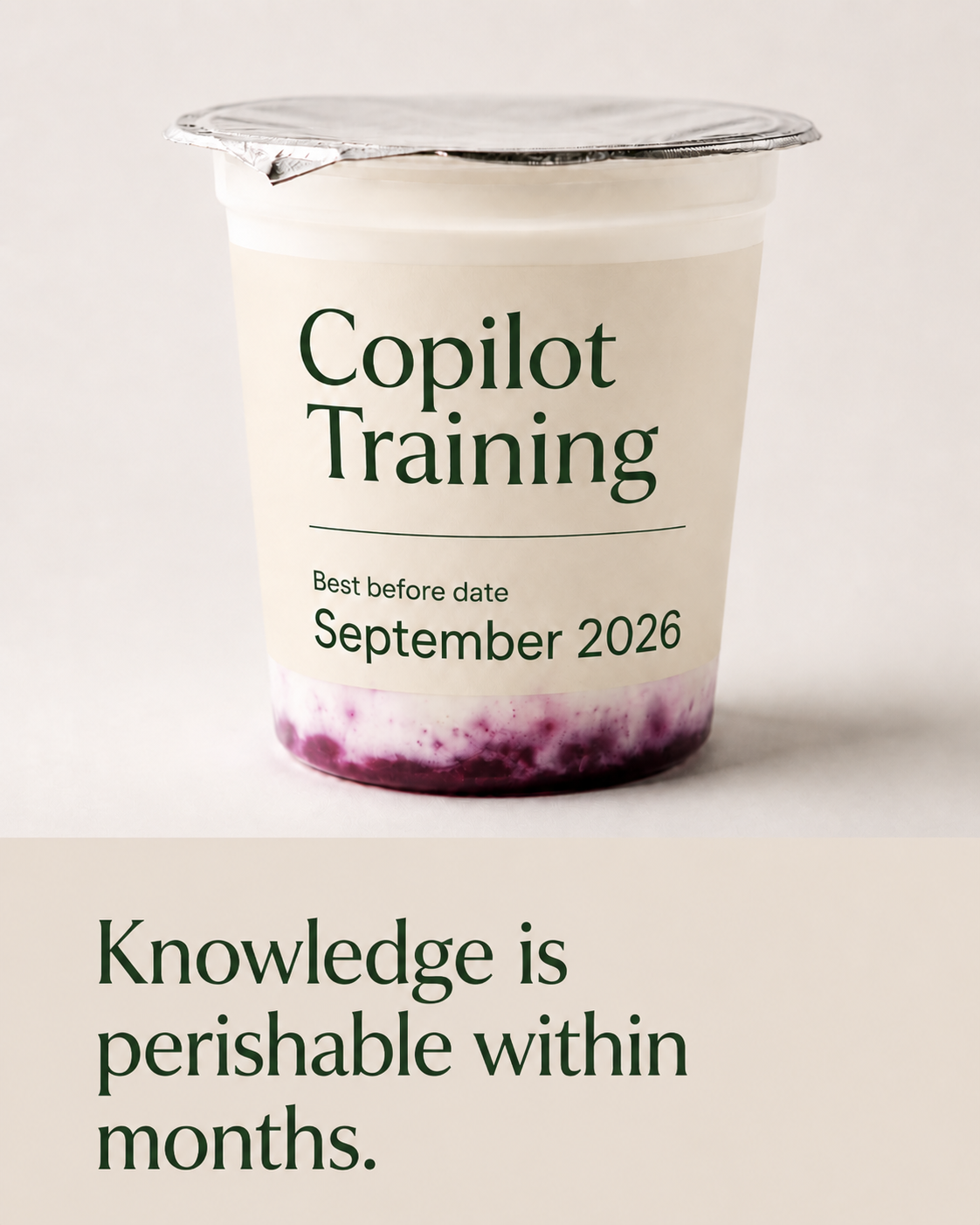
The problem isn't a lack of effort on the part of L&D departments. The problem is structural: tool knowledge has a best-before date. Anyone who doesn't plan for this ends up maintaining a catalog of rapidly aging content and investing budget in training that is already outdated by the time it's finished.
The consequence is uncomfortable but clear: tool-specific training has to be treated as perishable content – with short development cycles, regular review, and the willingness to replace it quickly.
Thesis 2: Training on demand. Develop for months and you're too late.
If tool knowledge ages quickly, L&D has to become fundamentally faster. A curriculum that needs six months of lead time cannot respond to changes that are happening today.
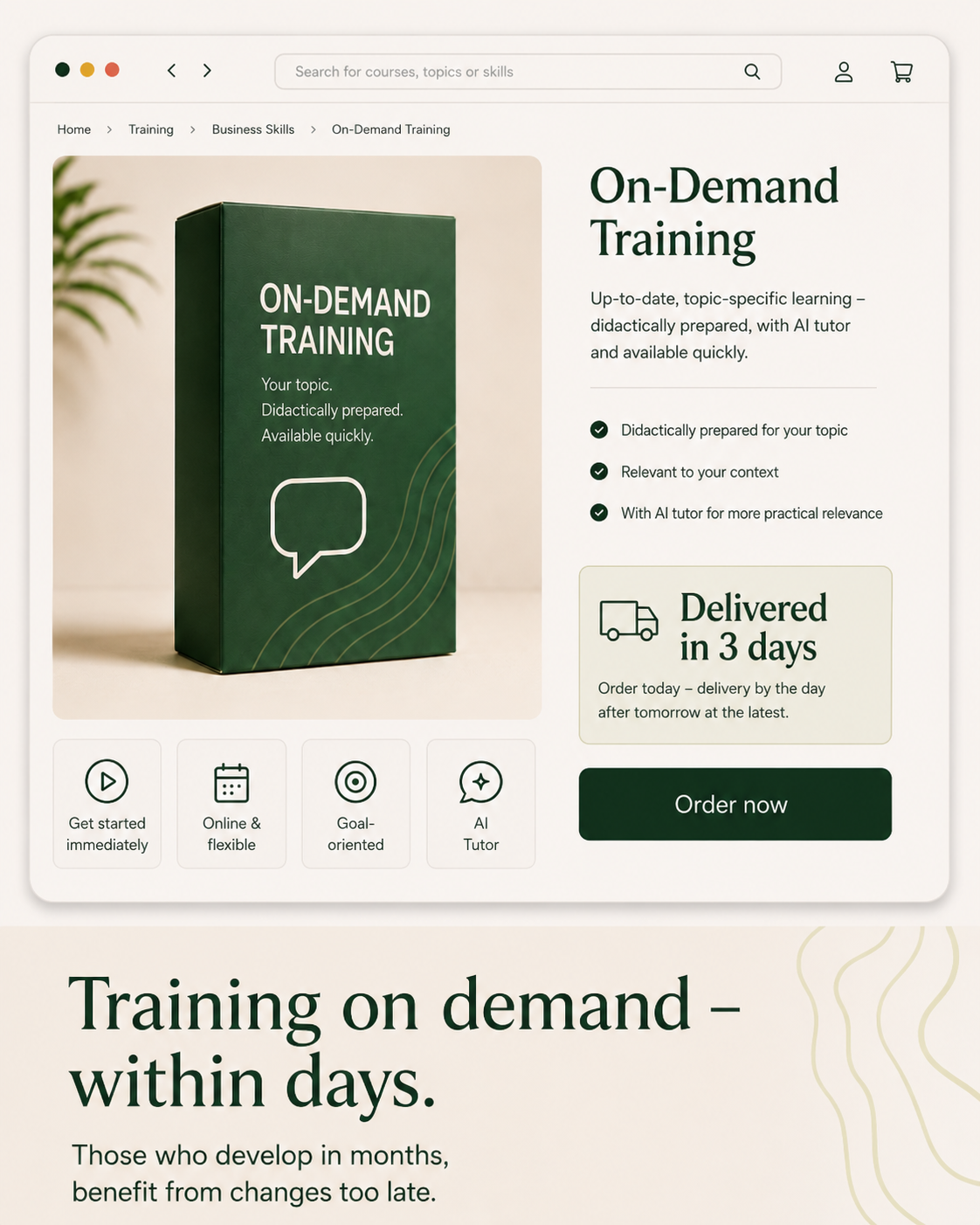
To make matters worse, training developed too far removed from day-to-day work loses its relevance before it's ever deployed. The longer the path from need to finished training, the bigger the gap to employees' lived reality.
On top of that comes the bottom-up dimension: no one knows better which specific skills are currently missing than the people doing the work. Training needs have to be identified from the bottom up and addressed quickly – not managed top-down in an annual plan.
The model we need is training on demand: a concrete need arises, and within days a usable learning resource is available. Not perfectly polished, but current, contextually relevant, and immediately usable.
Thesis 3: Teach future skills instead of time-bound details
There are skills that don't go out of date because they aren't tied to a specific tool or field of knowledge. Judgment. Critical thinking. The ability to decide under uncertainty. Tolerance for ambiguity. In research, these are called future skills or core cognitive competencies.
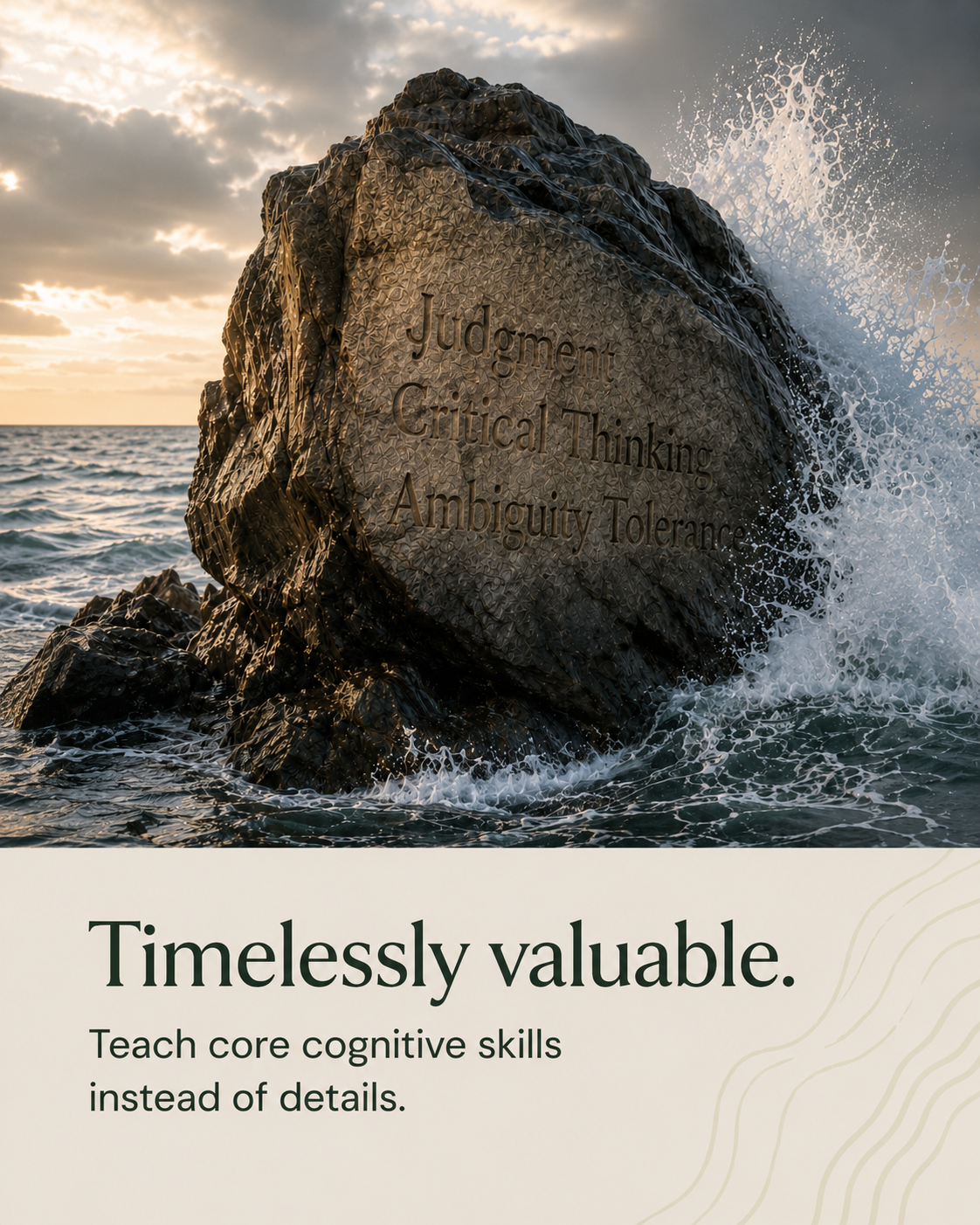
In a world of constant change, future skills become more important, not less. Those who know how they think can adapt to new content faster. Those who only know what to think lose their footing the moment the content shifts.
In combination with AI in particular, this becomes decisive: AI delivers answers in seconds. What AI cannot do is judge, weigh, and decide when a situation is complex and ambiguous. That is exactly what future skills are. Those who master them use AI outputs better, question them more precisely, and reach better results because they know which questions to ask.
The problem: most L&D programs still predominantly train short-lived detail knowledge. The question of which competencies an employee will need in three years is rarely asked. The question of which course they should take this year, very often.
Thesis 4: Experience transfer instead of knowledge transfer
Today, knowledge is available anytime and anywhere. If you have a question, you ask ChatGPT, Perplexity, or an AI assistant. The barrier to knowledge has practically disappeared.

What isn't on demand is experience. The systemic knowledge that builds up over years. The intuition that tells you when a rule applies and when it doesn't. The understanding of how things really work in a specific organization – beyond the org chart.
At the same time, many organizations observe that junior roles are being filled less often, because AI tools take over simple tasks and newcomers get fewer opportunities to build experience organically. The pool of experienced people is shrinking relative to demand.
The optimum lies in the combination: excellent use of AI tools plus human experience as the decisive differentiator. Experience gives tool usage direction, context, and judgment. Systemic understanding, established approaches, and the knowledge of how things really work can't be googled. That is exactly what sets organizations and their employees apart.
That's why the focus has to be on experience transfer. TreadEd makes it possible to design dialogue-based learning paths that guide learners through real scenarios. The AI tutor is shaped by experienced employees who contribute their knowledge and experience and retain full didactic control over what is passed on. This makes experience scalable without losing depth.
Thesis 5: Only deep, penetrating learning is worth it
A training that ticks off a list of bullet points was always suboptimal. Today it's practically worthless.
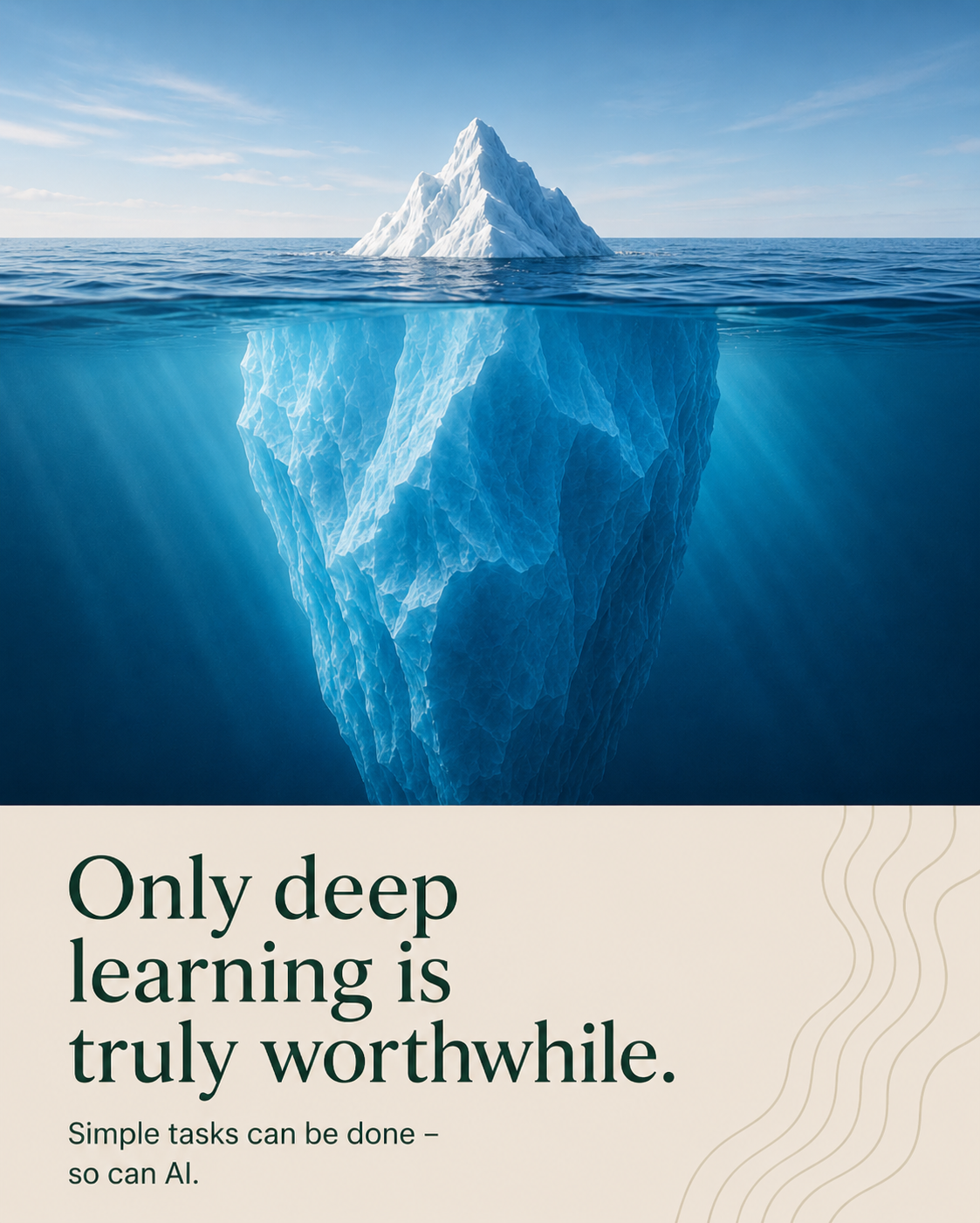
Why? Because the simple tasks – summarizing information, executing standard processes, answering recurring questions – are handled by AI systems faster, more cheaply, and more reliably than by people trained superficially to do them.
What remains is what AI cannot do: truly understanding complex relationships. Penetrating systems. Making decisions in ambiguous situations. On Bloom's taxonomy, this corresponds to the higher levels: analysis, synthesis, evaluation – not mere remembering and understanding.
A training should therefore only be considered successful when it produces real competence – not the feeling of having heard something. That's a different design ambition: less content, more engagement. Fewer clicks through slides, more situations in which learners are genuinely challenged. Relationships have to be understood. Processes have to be penetrated. Only then does the depth emerge that, in combination with AI, creates real added value.
Conclusion: L&D has to reinvent itself
These five theses are interconnected. Tool knowledge ages – so we need speed. Speed alone isn't enough – so we need timeless future skills. Competencies without depth are worthless – so we need genuine penetration. And the most valuable thing an organization has is experience – which has to be passed on at scale before it's lost.
L&D was built as an institution for stability. The world it operates in today is anything but stable. That's not a reproach – it's a structural problem that needs structural answers.
FAQ
What is tool knowledge, and why does it become outdated so quickly?
Tool knowledge is specific knowledge about how to operate and use the features of a software tool. It becomes outdated quickly because modern tools – especially AI-powered applications – are updated on a monthly cycle with new features and changed interfaces. A training developed today often reflects an outdated version within six months.
What are future skills, and why are they so important now?
Future skills are core cognitive competencies that work independently of any specific subject matter: judgment, critical thinking, tolerance for ambiguity. In combination with AI, they become the decisive differentiator, because while AI delivers answers, it cannot judge. Those who master future skills use AI outputs better and reach more robust decisions.
What's the difference between knowledge transfer and experience transfer?
Knowledge transfer passes on facts, processes, and information – the things an AI can now retrieve too. Experience transfer passes on how experienced employees judge and decide in complex, ambiguous situations. This systemic knowledge isn't available on demand – it has to be passed on actively and with didactic control.
What does deep, penetrating learning mean in practice?
Deep, penetrating learning means learning that goes beyond merely absorbing information. Learners understand relationships and can apply, analyze, and evaluate knowledge – corresponding to the higher levels of Bloom's taxonomy (analysis, synthesis, evaluation). Superficial learning that only produces factual knowledge is increasingly being replaced by AI systems.
How can experience transfer be scaled?
Personal mentoring is effective but not scalable. TreadEd makes it possible to design dialogue-based learning paths in which experienced employees shape the AI tutor and pass on their knowledge under didactic control. Learners are guided through real scenarios and supported individually – making experience scalable without losing depth.

About the author
Daniel Kaulbach is Co-Founder of TreadEd.
TreadEd is a creator tool that makes it possible to design dialogue-based learning paths in which learners are always optimally supported through one-on-one guidance by an AI tutor. Experienced employees fully shape the tutor didactically, passing on their knowledge and experience at scale.
Related posts
Mastery Learning: Why Bloom's Idea Only Works Now
Benjamin Bloom's nearly 60-year-old idea of mastery learning has always foundered on practicality – too costly for everyday use. Daniel Kaulbach explains why AI changes that now, and how TreadEd's AI companion shifts learning from the course to the goal.
October 28, 2026
From Training to the Real Thing: What's New at TreadEd
With our new release, learners can show what they know and speak freely instead of typing. Creators get an agent that keeps the whole learning path in view. Christoph explains why these belong together.
October 14, 2026
“A Protected Space to Practice”: Why LeWe GmbH Works With TreadEd
Alex and Martin from LeWe GmbH share why they've built TreadEd into their trainings and workshops – and how a protected space to practice elevates their work as trainers and consultants.
July 30, 2026